
- Home
- Media Center
-
Events
- Wuzhen Summit
- Regional Forums
- Practice Cases of Jointly Building a Community with a Shared Future in Cyberspace
- World Internet Conference Awards for Pioneering Science and Technology
- The Light of Internet Expo
- Straight to Wuzhen Competition
- Global Youth Leadership Program
- WIC Distinguished Contribution Award
- Membership
- Research & Cooperation
- Digital & AI Academy
-
Reports
- Collection of cases on Jointly Building a Community with a Shared Future in Cyberspace
- Collection of Shortlisted Achievements of World Internet Conference Awards for Pioneering Science and Technology
- Reports on Artificial Intelligence
- Reports on Cross—Border E—Commerce
- Reports on Data
- Outcomes of Think Tank Cooperation Program
- Series on Sovereignty in Cyberspace Theory and Practice
- Other Achievements
- About WIC
- 中文 | EN


Workforce rides AI wave as new roles emerge


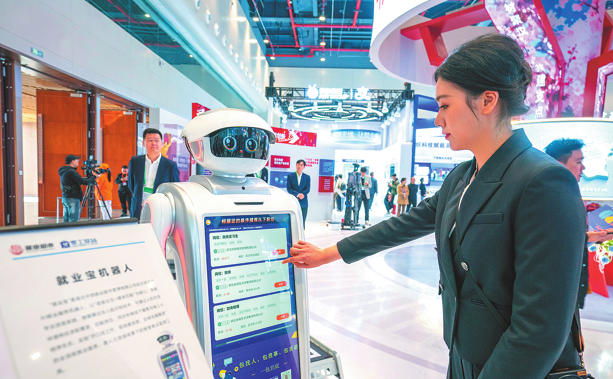
A job seeker consults a robot for recruitment information during the 3rd National Conference on the Development of Human Resources Services in Wuhan, Hubei province, on Nov 28. [Photo for China Daily]
Every applied AI scenario — from medical imaging to personalized learning systems — depends on turning "technical potential" into commercially viable products, according to Zhaopin. Among these front-line roles, AI product managers are among the most sought-after, with an average of 68 applicants for each opening.
Wan Wan, an HR manager at a Chengdu-based AI startup in Sichuan province who asked for anonymity, said the company prioritizes hands-on experience. "We don't work on the programming of the model, but on model applications," she said. "We look for candidates with experience in prompt engineering and intelligent agents, especially if they've used them in projects or coursework."
Her company receives roughly 800 resumes for each position, with about 80 percent from experienced backgrounds and 20 percent from campuses or interns.
In contrast, the "second-line" roles — algorithm engineers and model researchers — form the technical backbone of the industry. According to a report from Wise Talent Information Technology, 47 percent of such postings require a master's degree or above.
Chen Xiaobao, a large-model algorithm engineer at a leading tech firm, describes hiring as intensely selective. Candidates must fit the team's research direction, and more than half of his colleagues hold doctorates. Minimum qualifications often include a master's degree from top institutions such as the University of Chinese Academy of Sciences.
As AI undergraduate programs were only introduced in 2019, most professionals in these roles come from related fields, including computer science, software engineering, electronics and mechanical engineering.
"Employers focus on relevant technical ability," the report noted. "Algorithms are central, involving mathematics, statistics and computer science. Deep learning demands expertise in neural networks and programming skills."
As product and engineering teams build the AI tools of tomorrow, another vital workforce is teaching them how to think. Often called AI trainers or data labelers, their task is not to code, but to educate — turning raw data into algorithmic understanding.
The World Internet Conference (WIC) was established as an international organization on July 12, 2022, headquartered in Beijing, China. It was jointly initiated by Global System for Mobile Communication Association (GSMA), National Computer Network Emergency Response Technical Team/Coordination Center of China (CNCERT), China Internet Network Information Center (CNNIC), Alibaba Group, Tencent, and Zhijiang Lab.