
- Home
- Media Center
-
Events
- Wuzhen Summit
- Regional Forums
- Practice Cases of Jointly Building a Community with a Shared Future in Cyberspace
- World Internet Conference Awards for Pioneering Science and Technology
- The Light of Internet Expo
- Straight to Wuzhen Competition
- Global Youth Leadership Program
- WIC Distinguished Contribution Award
- Membership
- Research & Cooperation
- Digital & AI Academy
-
Reports
- Collection of cases on Jointly Building a Community with a Shared Future in Cyberspace
- Collection of Shortlisted Achievements of World Internet Conference Awards for Pioneering Science and Technology
- Reports on Artificial Intelligence
- Reports on Cross—Border E—Commerce
- Reports on Data
- Outcomes of Think Tank Cooperation Program
- Series on Sovereignty in Cyberspace Theory and Practice
- Other Achievements
- About WIC
- 中文 | EN


Workforce rides AI wave as new roles emerge


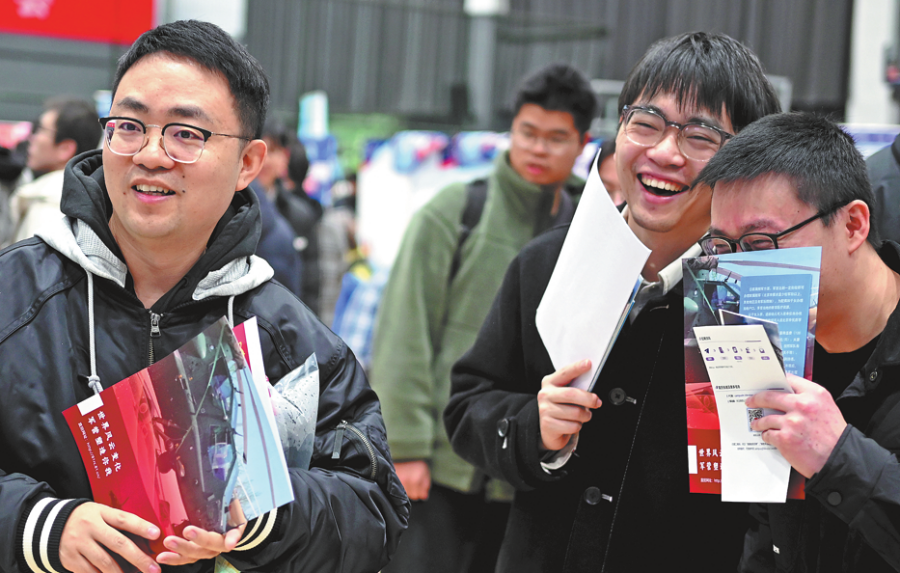
Students make inquiries at a recruitment booth during the job fair in Nanjing on March 14. [Photo/China News Service]
Peking University researchers found jobs such as accountants, editors and junior programmers faced higher exposure to automation, while many blue-collar jobs were less affected. "AI excels at repetitive, rules-based tasks," researcher Zhang Dandan said. "Mid-skill jobs are most vulnerable."
As the AI wave accelerates, many young people are asking the question: if AI is rewriting the future, how do I position myself to thrive?
Lin Xiao, a social sciences graduate from Tsinghua University, represents another case in point. After two career shifts — from the civil service to international education — she joined an AI startup in March. Like Hua, her decisions were straightforward, aimed at ensuring she was positioned for the next wave of opportunity.
While still a student, Lin interned at an autonomous driving company where she enjoyed the tech-focused marketing work. After leaving her position at the end of 2024, she entered the AI recruitment boom now underway in China. "I wanted a dynamic role where I could keep learning and connect with more people," Lin said.
At her new company, she manages everything from social media, content, and community operations to key opinion leader, or KOL, collaborations, while also coordinating with product teams on strategy and improvements.
For Lin, technology represents "the core force changing the world in this era". Working in AI keeps her at the forefront of that change — a continuous learning experience that is shaping both her career and her outlook.
Neither Hua nor Lin comes from a STEM (science, technology, engineering and mathematics) background, yet both have carved out critical roles in China's fast-moving AI landscape.
Hua said sales and marketing teams serve as the "front line" of AI, translating complex technical capabilities into tangible value for customers. She spends her days explaining AI solutions to enterprises, while Lin identifies early adopters for her startup's products across global markets.
Their hybrid skill sets — combining technical literacy, product insight, market strategy and cross-team communication — are increasingly prized as AI moves from research labs into real-world applications, industry insiders said.
The World Internet Conference (WIC) was established as an international organization on July 12, 2022, headquartered in Beijing, China. It was jointly initiated by Global System for Mobile Communication Association (GSMA), National Computer Network Emergency Response Technical Team/Coordination Center of China (CNCERT), China Internet Network Information Center (CNNIC), Alibaba Group, Tencent, and Zhijiang Lab.