
- Home
- Media Center
-
Events
- Wuzhen Summit
- Regional Forums
- Practice Cases of Jointly Building a Community with a Shared Future in Cyberspace
- World Internet Conference Awards for Pioneering Science and Technology
- The Light of Internet Expo
- Straight to Wuzhen Competition
- Global Youth Leadership Program
- WIC Distinguished Contribution Award
- Membership
- Research & Cooperation
- Digital & AI Academy
-
Reports
- Collection of cases on Jointly Building a Community with a Shared Future in Cyberspace
- Collection of Shortlisted Achievements of World Internet Conference Awards for Pioneering Science and Technology
- Reports on Artificial Intelligence
- Reports on Cross—Border E—Commerce
- Reports on Data
- Outcomes of Think Tank Cooperation Program
- Series on Sovereignty in Cyberspace Theory and Practice
- Other Achievements
- About WIC
- 中文 | EN


Secretary-general Ren Xianliang Attends the Opening Ceremony of the 2025 World Internet Conference Global Elite Training


On November 8, Ren Xianliang, secretary-general of the World Internet Conference and dean of the WIC Digital Academy (WICDA), attended and delivered a speech at the opening ceremony of the 2025 World Internet Conference Global Elite Training.
Ren Xianliang extended a warm welcome to the senior representatives from government departments in over 30 countries and regions who had traveled from afar. He expressed high expectations for this cross-regional, cross-disciplinary initiative, highlighting the profound value and significance of such digital exchange and learning.
He emphasized that in the face of opportunities and challenges brought by innovations in digital-intelligent technologies, represented by artificial intelligence, no country can stand alone. We must collectively ponder: How can we seize the opportunities of digital transformation to make technological innovation a true "accelerator" of development? How can we avoid the high costs of technological trial and error, ensuring a more efficient and pragmatic transformation journey? How can we ensure that no one is "left behind" in the digital wave, allowing the benefits of development to reach more people? How can we prevent the digital divide from evolving into an insurmountable "digital-intelligence divide" in the smart era, thereby safeguarding fairness and inclusiveness in global development?
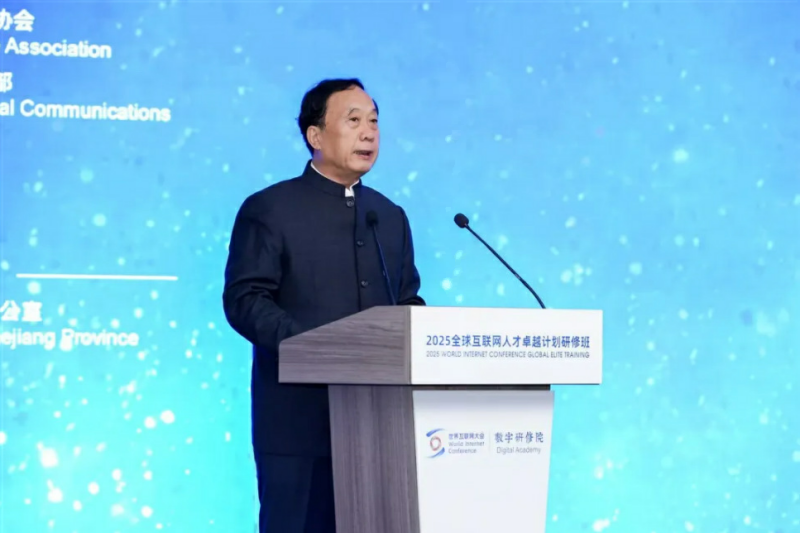
Ren Xianliang stated that only by adhering to the principle of extensive consultation, joint contribution and shared benefit and working together to build a community with a shared future in cyberspace can the dividends of digital technology better benefit all humanity. This, he emphasized, is precisely the original intention and core purpose behind the establishment of the WICDA—to provide capacity-building support to countries worldwide.
He set forth three expectations for the trainees, focusing on the integration of learning and practical application: First, begin with a spirit of "open cooperation", encouraging participants to actively share practical challenges and solutions from their respective countries in areas such as digital transformation, thereby injecting new momentum into the collaborative development of the global digital economy. Second, lay the foundation with "security and inclusiveness", urging everyone to integrate this concept throughout the entire process of digital governance to jointly foster a stable and inclusive global cyberspace. Third, let a "digital-intelligent future" steer the course, addressing the profound and complex changes and challenges currently faced by economic globalization, enabling digital and intelligent forces to become both an engine for domestic growth and a support for global sustainable development, and working together to create a more resilient and dynamic digital future.
The opening ceremony was attended by over 40 senior representatives from various government departments, including commerce and trade, finance, digital development, science and technology, tourism, public administration, and natural resources, from countries across Asian, African, and Latin American countries, as well as leaders or representatives from 15 partner institutions of the WICDA.
The WICDA was officially launched in November 2024 to focus on key areas of the digital development. Their goal is to conduct training programs globally, especially for developing countries, to cultivate digital talents, empowering governments and enterprises in their digital transformation, bridging the global digital divide, and fostering the shared benefits of inclusive development.
The World Internet Conference (WIC) was established as an international organization on July 12, 2022, headquartered in Beijing, China. It was jointly initiated by Global System for Mobile Communication Association (GSMA), National Computer Network Emergency Response Technical Team/Coordination Center of China (CNCERT), China Internet Network Information Center (CNNIC), Alibaba Group, Tencent, and Zhijiang Lab.